
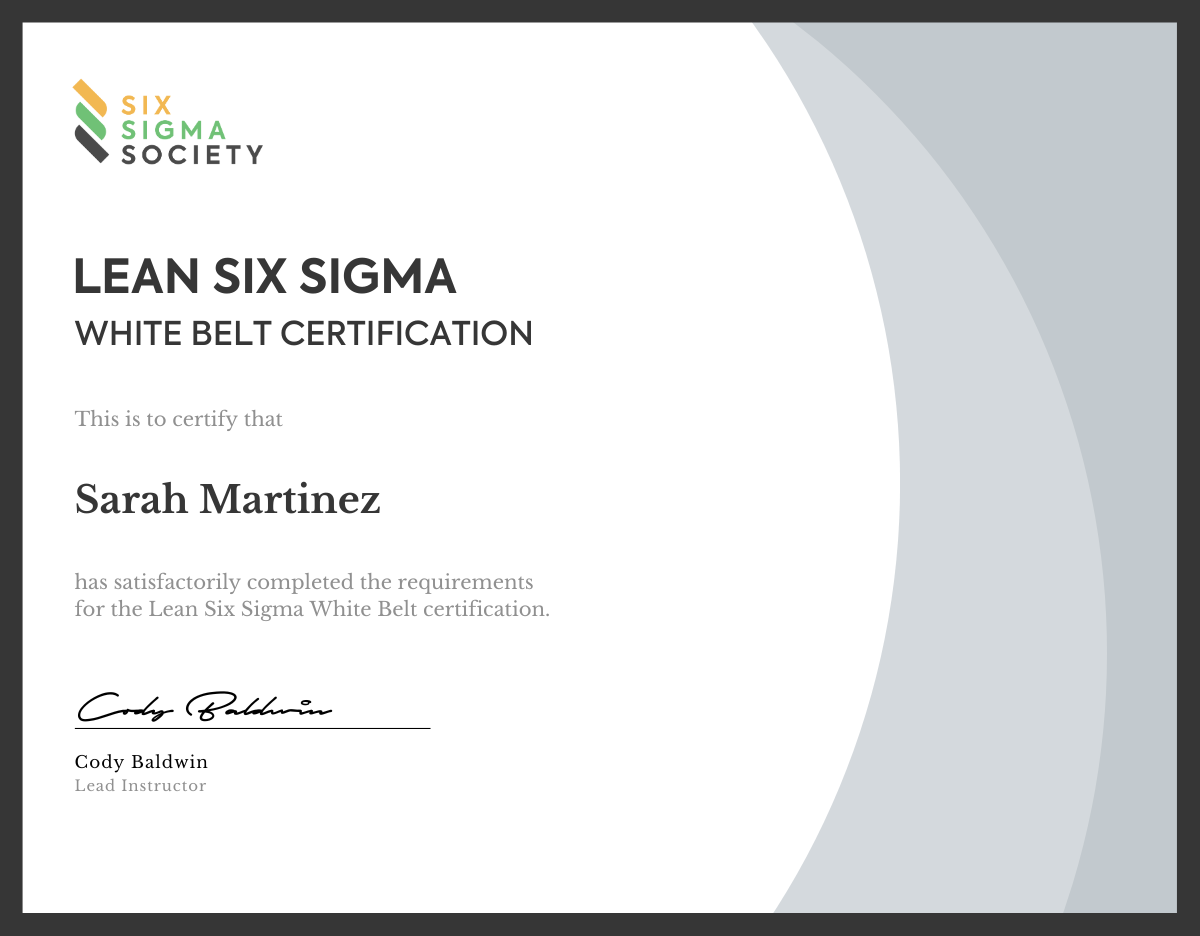
The Importance of Six Sigma Certification
Six Sigma is a methodology that focuses on improving processes by reducing defects and variations. It aims to enhance quality, increase efficiency, and ultimately drive customer satisfaction. In today’s competitive business landscape, organisations are increasingly turning to Six Sigma to streamline operations and achieve sustainable growth.
Obtaining Six Sigma certification demonstrates an individual’s proficiency in the methodology and signifies their commitment to excellence in process improvement. Here are some key reasons why Six Sigma certification is valuable:
- Enhanced Skills: Through Six Sigma training, professionals learn advanced tools and techniques for process improvement. They gain a deep understanding of statistical analysis, root cause analysis, and other methodologies that can drive significant results.
- Increased Employability: Employers value candidates with Six Sigma certification as it indicates their ability to drive quality initiatives within the organisation. Certified individuals are often sought after for roles that require process improvement expertise.
- Cost Savings: By implementing Six Sigma principles, organisations can identify and eliminate defects in processes, leading to cost savings and increased profitability. Certified professionals play a crucial role in driving these cost-saving initiatives.
- Customer Satisfaction: Improved processes result in higher quality products or services, which directly impact customer satisfaction. With Six Sigma certification, professionals can lead projects that focus on meeting customer needs and exceeding expectations.
In conclusion, Six Sigma certification is not only beneficial for individuals looking to advance their careers but also for organisations seeking to improve efficiency and quality. By investing in Six Sigma training and certification, professionals can enhance their skills, drive business improvements, and contribute to overall success.
Understanding Six Sigma Certification: Answers to 7 Common Questions
- Is Six Sigma really worth it?
- Are Six Sigma certifications worth it?
- What does 6 sigma stand for?
- How much does Six Sigma certification pay?
- How long is 6 Sigma certification?
- How long does it take to get 6 sigma certification?
- What is 6 Sigma certification for?
Is Six Sigma really worth it?
Many individuals and organisations often wonder, “Is Six Sigma really worth it?” The answer lies in the tangible benefits that Six Sigma certification can bring. By implementing Six Sigma methodologies, businesses can achieve significant improvements in quality, efficiency, and customer satisfaction. Certified professionals are equipped with the skills to identify and eliminate process defects, leading to cost savings and increased profitability. Ultimately, investing in Six Sigma certification can result in enhanced organisational performance, making it a valuable asset for those looking to drive continuous improvement and achieve sustainable success.
Are Six Sigma certifications worth it?
When considering the value of Six Sigma certifications, it is essential to weigh the benefits they offer against individual career goals and organisational needs. Six Sigma certifications can be worth it for professionals seeking to enhance their process improvement skills, increase employability in quality-focused roles, drive cost savings through defect reduction, and improve customer satisfaction by delivering high-quality products or services. Ultimately, the worth of Six Sigma certification lies in its ability to provide individuals with advanced tools and methodologies to make a tangible impact on business processes and quality outcomes.
What does 6 sigma stand for?
In the context of Six Sigma certification, the term “6 sigma” refers to a statistical measure that quantifies the level of quality in a process. Specifically, Six Sigma represents a standard deviation from the mean in a statistical distribution. Achieving Six Sigma quality means that the process is producing results with extremely low defect rates, typically around 3.4 defects per million opportunities. By striving for Six Sigma levels of quality, organisations aim to minimise variation, improve efficiency, and deliver consistent and high-quality products or services to customers.
How much does Six Sigma certification pay?
The salary potential for individuals with Six Sigma certification can vary depending on factors such as job role, industry, experience level, and geographical location. Generally, professionals holding Six Sigma certification may command higher salaries compared to their non-certified counterparts due to their specialised skills in process improvement and quality management. According to industry reports, Six Sigma-certified professionals in roles such as Six Sigma Black Belts or Master Black Belts often earn competitive salaries, with the potential for further increases based on performance and organisational requirements. It is essential for individuals considering Six Sigma certification to research salary trends in their specific field to gain a better understanding of the earning potential associated with this valuable credential.
How long is 6 Sigma certification?
When it comes to the duration of Six Sigma certification, the timeframe can vary depending on the level of certification and the training provider. Generally, Six Sigma certification programs range from a few days for basic levels like Yellow Belt to several weeks or months for more advanced levels such as Green Belt or Black Belt. Some training courses may be conducted intensively over a shorter period, while others may be spread out over an extended duration to allow for deeper learning and practical application of Six Sigma principles. It is essential for individuals considering Six Sigma certification to research different training options and choose a program that aligns with their learning preferences and career goals.
How long does it take to get 6 sigma certification?
The duration to obtain Six Sigma certification can vary depending on the level of certification and the individual’s pace of learning. Typically, completing a Yellow Belt certification may take a few days to a few weeks, while Green Belt certification could require several weeks to a few months of dedicated study and project work. For those pursuing Black Belt certification, the process may take several months to a year, as it involves in-depth training, project implementation, and demonstrating mastery of Six Sigma principles. Ultimately, the time taken to achieve Six Sigma certification is influenced by factors such as prior knowledge, commitment to learning, and the complexity of projects undertaken during the certification process.
What is 6 Sigma certification for?
Six Sigma certification is designed to equip individuals with the knowledge and skills needed to drive process improvements within organisations. By undergoing Six Sigma training and obtaining certification, professionals learn how to identify areas of inefficiency, reduce defects, and enhance overall quality. The primary goal of Six Sigma certification is to empower individuals to lead projects that result in cost savings, increased customer satisfaction, and sustainable growth. Ultimately, Six Sigma certification enables individuals to play a pivotal role in driving continuous improvement and operational excellence across various industries.