
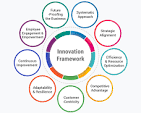
Building an Effective Innovation Framework
Innovation can help an organisation respond to change, solve problems and create lasting value. But new ideas rarely succeed through enthusiasm alone. They need a clear route from identifying an opportunity to testing, improving and putting a solution into practice. An innovation framework provides that route.
What is an innovation framework?
An innovation framework is a set of principles, processes and tools that helps people develop and implement new ideas. It gives teams a shared way to explore challenges, assess opportunities and learn from experiments. Rather than prescribing every answer, a useful framework creates the conditions for good ideas to emerge and be tested responsibly.
Frameworks can be adapted to suit different organisations. A small charity, a public service and a multinational business may have very different resources and requirements, but each can benefit from a clear approach to learning and change.
The essential elements
A clear purpose
Innovation works best when it is connected to a meaningful goal. That goal might be improving a customer experience, reducing waste, making a service more accessible or developing a new source of income. A clear purpose helps teams focus their efforts and judge whether an idea is worth pursuing.
An understanding of the problem
Before proposing solutions, teams should understand the people and circumstances involved. This may include speaking with customers, staff, partners or communities; examining existing data; and observing how a service or process works in practice. A well-defined problem is a stronger starting point than an untested assumption.
Space for ideas
People need time and permission to explore different possibilities. Encouraging contributions from a range of roles and backgrounds can reveal perspectives that might otherwise be missed. A culture of curiosity also makes it easier to question established practices without treating every suggestion as a commitment.
Experimentation and learning
Promising ideas should be tested on a manageable scale before they are introduced more widely. Prototypes, trials and small pilots can show what works, what needs to change and whether an idea addresses the original problem. Experiments should have clear questions and measures, so that teams learn from the results rather than simply confirming their expectations.
Evaluation and decision-making
Organisations need agreed criteria for deciding what happens next. These might include the potential benefit, cost, feasibility, risks, accessibility and environmental impact of an idea. Not every experiment will lead to implementation, and that is not necessarily a failure. Ending an approach that does not work can save time and resources while providing useful insight.
Implementation and review
When an idea is ready to move forward, teams need a plan for delivery. This may involve assigning responsibility, securing resources, preparing staff and communicating changes to the people affected. After implementation, regular review helps establish whether the solution is delivering its intended benefits and what further improvements may be needed.
Creating the right conditions
A framework is only effective when it is supported by the organisation’s culture. Leaders can help by making innovation part of everyday work, providing time for collaboration and recognising thoughtful experimentation. Staff should feel able to raise concerns and share lessons, including when a trial does not produce the hoped-for outcome.
It is also important to include people who will use or be affected by a proposed solution. Involving them throughout the process can make ideas more relevant, practical and inclusive. Accessibility, privacy, safety and ethical considerations should be considered from the outset, not added at the final stage.
Measuring progress
Innovation is not measured solely by the number of ideas generated or projects launched. Useful measures relate to the purpose of the work. Depending on the project, these might include improved satisfaction, reduced waiting times, lower operating costs, greater participation or a measurable environmental benefit.
Teams can also track how effectively they learn: how quickly they test an assumption, whether they involve the right people and how often findings inform decisions. Combining outcome measures with learning measures gives a fuller picture of progress.
Start simple and improve over time
An innovation framework does not need to be complicated. A basic cycle of understanding a problem, developing ideas, testing them and reviewing the results can provide a strong foundation. As teams gain experience, they can refine the process, add suitable tools and make responsibilities clearer.
The aim is not innovation for its own sake. It is to build a reliable way to find better responses to real needs. With a clear purpose, thoughtful experimentation and a willingness to learn, an innovation framework can help turn promising ideas into practical, lasting improvements.
9 Essential Tips for Building an Effective Innovation Framework
- Set clear innovation goals.
- Start with user needs.
- Create a simple process.
- Invite diverse perspectives.
- Test ideas early.
- Learn from small failures.
- Assign clear ownership.
- Track outcomes, not activity.
- Review and improve regularly.
Set clear innovation goals.
Set clear innovation goals so everyone understands what the organisation is trying to achieve and how success will be recognised. Goals should respond to real needs, align with wider priorities and be specific enough to guide decisions—for example, improving a service, reducing waste or making a process more accessible. Clear goals help teams focus their efforts, choose relevant experiments and measure whether new ideas are delivering meaningful results.
Start with user needs.
Start with user needs by taking time to understand the people who will use or be affected by an idea. Speak with them, observe their experiences and identify the challenges they face before designing a solution. This helps ensure innovation addresses a genuine problem, rather than an assumption, and makes the final outcome more useful, accessible and relevant.
Create a simple process.
Create a simple process that helps people move an idea from first thought to practical test. For example, agree on the problem, gather ideas, choose one to trial, review what happened and decide what to do next. Keep each step clear, with named responsibilities and realistic timescales, but avoid unnecessary paperwork or approvals. A straightforward process makes it easier for everyone to take part, learn from experiments and improve ideas as they develop.
Invite diverse perspectives.
Invite diverse perspectives. Innovation is stronger when it draws on different experiences, skills and points of view. Involve people from across your organisation, as well as customers, partners and communities affected by the challenge. This can reveal overlooked needs, question assumptions and spark more inclusive solutions. Create space for everyone to contribute, and make sure differing views are heard and considered.
Test ideas early.
Test ideas early. A small, early test can reveal whether an idea addresses the real problem before significant time or money is invested. Use a simple prototype, trial or conversation with the people affected, then gather feedback and learn from the results. Early testing makes it easier to adapt, improve or stop an idea while changes are still manageable.
Learn from small failures.
Learning from small failures is an essential part of an effective innovation framework. Testing an idea on a limited scale helps teams spot weaknesses early, before they become costly or affect more people. Treat results that fall short as useful evidence: discuss what happened, identify assumptions that proved wrong and adjust the approach. By making experiments safe, proportionate and focused on learning, organisations can build confidence, improve ideas and make better-informed decisions.
Assign clear ownership.
Assigning clear ownership helps turn an innovation framework from a set of ideas into action. Give each initiative a named person who is responsible for coordinating next steps, keeping others informed and ensuring that decisions are made. Make their authority, responsibilities and available resources clear, while involving the people whose expertise or input is needed. Ownership should encourage progress and accountability, not make one person responsible for every task or outcome.
Track outcomes, not activity.
Track outcomes, not activity, to understand whether innovation is making a meaningful difference. Counting workshops held, ideas generated or prototypes built may show how much work has taken place, but not whether it has solved a problem. Instead, define clear measures linked to the intended benefit, such as improved user satisfaction, reduced costs or faster service. Review these measures over time, and use what you learn to guide the next steps.
Review and improve regularly.
Reviewing and improving your innovation framework regularly helps keep it relevant as your organisation’s needs, resources and circumstances change. Gather feedback from the people using the framework, assess what is working and where ideas are getting stuck, and use lessons from both successful and unsuccessful projects to make practical adjustments. Even small, consistent improvements can make the process more effective, inclusive and responsive over time.