
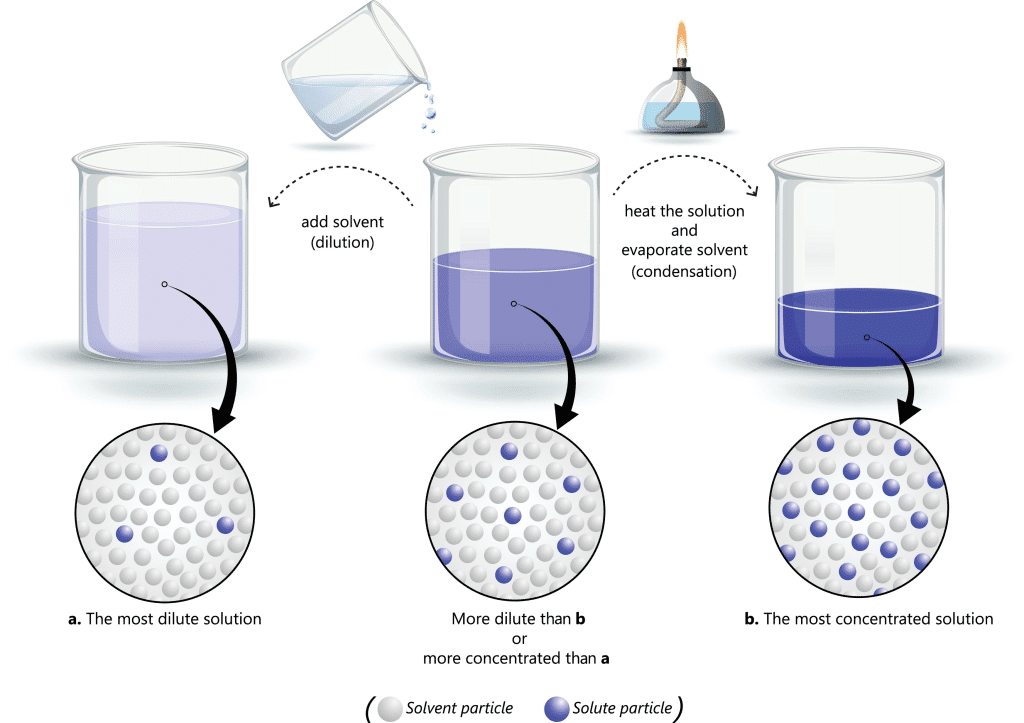
The Science Behind Saturated Solutions
In the realm of chemistry, saturated solutions play a crucial role in understanding the behaviour of solutes and solvents. But what exactly is a saturated solution?
A saturated solution is a solution in which the maximum amount of solute has been dissolved in a solvent at a specific temperature. This equilibrium state occurs when any additional solute added will not dissolve, leading to excess solute settling at the bottom of the container.
How Does it Work?
When a solute is added to a solvent, it dissolves until the point where no more can be absorbed. At this stage, the solution is said to be saturated. The ability of a solvent to dissolve a solute depends on factors such as temperature and pressure.
Applications
Saturated solutions have various practical applications. For example, they are used in chemistry labs to conduct experiments where precise concentrations of solutions are required. They are also utilised in industries such as pharmaceuticals and food production for manufacturing processes.
Importance in Chemistry
Understanding saturated solutions is essential for studying concepts like solubility and precipitation reactions. By manipulating conditions such as temperature or pressure, chemists can control the saturation levels of solutions and predict how different substances will interact.
In Conclusion
Saturated solutions are fundamental to many aspects of chemistry and industry. Their properties provide valuable insights into how substances interact and behave under specific conditions, making them a cornerstone of scientific research and practical applications.
Five Advantages of Saturated Solutions: From Accurate Measurements to Industrial Applications
- Saturated solutions provide a clear indication of the maximum solubility of a solute in a given solvent at a specific temperature.
- They are crucial for conducting precise experiments in chemistry, ensuring accurate measurements and results.
- Saturated solutions are used in various industries for manufacturing processes that require controlled concentrations of solutions.
- Understanding saturated solutions helps predict how substances will behave under different conditions, aiding in the design of new materials and products.
- They play a key role in studying solubility and precipitation reactions, contributing to advancements in scientific research and applications.
Challenges of Saturated Solutions: Limited Solubility, Precipitation Risks, and More
- Limited solubility
- Precipitation risk
- Difficulty in concentration control
- Temperature dependency
- Slow dissolving process
- Storage challenges
Saturated solutions provide a clear indication of the maximum solubility of a solute in a given solvent at a specific temperature.
Saturated solutions offer a valuable insight into the maximum solubility of a solute in a particular solvent at a defined temperature. By reaching equilibrium where no more solute can dissolve, saturated solutions provide a clear indication of the limit to which a solute can be dissolved in the solvent under those specific conditions. This information is crucial for various applications in chemistry, allowing scientists to determine precise concentrations of solutions and predict how different substances will behave when reaching their saturation point. Understanding the maximum solubility of a solute is essential for conducting experiments, manufacturing processes, and advancing scientific knowledge in the field of chemistry.
They are crucial for conducting precise experiments in chemistry, ensuring accurate measurements and results.
Saturated solutions play a vital role in conducting precise experiments in chemistry by ensuring accurate measurements and results. By reaching a state where no more solute can dissolve, saturated solutions provide a stable environment for researchers to control the concentration of solutes with precision. This allows for consistent and reliable data collection, making saturated solutions an essential tool for achieving reproducible outcomes in scientific investigations.
Saturated solutions are used in various industries for manufacturing processes that require controlled concentrations of solutions.
Saturated solutions offer a significant advantage in various industries by providing a precise and controlled concentration of solutions essential for manufacturing processes. By reaching equilibrium where no more solute can dissolve, these solutions ensure consistency and accuracy in the production of various products. Industries such as pharmaceuticals, food production, and chemical manufacturing rely on saturated solutions to maintain specific concentrations needed for their operations, highlighting the crucial role these solutions play in ensuring quality and efficiency in manufacturing processes.
Understanding saturated solutions helps predict how substances will behave under different conditions, aiding in the design of new materials and products.
Understanding saturated solutions is a valuable pro as it enables scientists and researchers to predict how substances will interact and behave under varying conditions. This predictive capability plays a crucial role in the design and development of new materials and products. By knowing the saturation levels of solutions, experts can tailor their compositions to achieve desired properties, leading to innovations in fields such as materials science, pharmaceuticals, and engineering. This knowledge empowers professionals to create more efficient processes and products that meet specific requirements, ultimately driving progress and advancements in various industries.
They play a key role in studying solubility and precipitation reactions, contributing to advancements in scientific research and applications.
Saturated solutions play a vital role in the study of solubility and precipitation reactions, making significant contributions to advancements in scientific research and practical applications. By understanding how solutes behave when dissolved in solvents to their maximum capacity, researchers can manipulate these conditions to predict and control chemical reactions. This knowledge not only enhances our understanding of fundamental chemical principles but also enables the development of innovative technologies and processes in various industries, from pharmaceuticals to environmental science.
Limited solubility
One drawback of saturated solutions is their limited solubility, which imposes a cap on the amount of solute that can be dissolved in a given solvent. This restriction can pose challenges when attempting to dissolve larger quantities of a solute, as the solution reaches its saturation point relatively quickly. The limited capacity for solute dissolution in saturated solutions can hinder certain experiments or industrial processes that require high concentrations of dissolved substances, thereby necessitating alternative approaches or modifications to achieve desired outcomes.
Precipitation risk
Excess solute in a saturated solution poses a significant con in the form of precipitation risk. When conditions such as temperature or pressure change, the excess solute that is unable to remain dissolved may precipitate out of the solution. This can result in the formation of solid particles, which not only alters the composition of the solution but also creates potential issues such as clogging in pipelines or equipment. Managing precipitation risk is crucial when working with saturated solutions to maintain stability and prevent unwanted consequences.
Difficulty in concentration control
Achieving precise concentrations can be challenging when working with saturated solutions due to their equilibrium state. Since a saturated solution already contains the maximum amount of solute that can be dissolved in a specific amount of solvent at a given temperature, any attempt to alter the concentration by adding more solute will not result in further dissolution. This difficulty in concentration control can pose a significant challenge in laboratory settings and industrial processes where accurate measurements and specific concentrations are crucial for desired outcomes. Scientists and researchers must carefully consider the limitations of saturated solutions when aiming to manipulate concentrations for experiments or production purposes.
Temperature dependency
The temperature dependency of solubility in saturated solutions poses a significant challenge in experimental setups. As temperature fluctuates, the solubility of solutes can change, leading to inconsistencies in the saturation levels of solutions. This variability complicates the process of maintaining precise concentrations and can introduce errors in experimental results. Researchers and scientists must carefully consider and control temperature conditions to ensure the reliability and accuracy of their experiments involving saturated solutions.
Slow dissolving process
One drawback of saturated solutions is the slow dissolving process, where it can take a considerable amount of time for a solute to completely dissolve in the solution. This delay in dissolution can impact the efficiency of certain applications that require quick or precise results. The prolonged time required for full dissolution may hinder processes that rely on immediate or rapid solvation, potentially causing delays in experiments or industrial operations where time is of the essence.
Storage challenges
Storage challenges present a significant drawback of saturated solutions. Due to their nature, saturated solutions demand meticulous storage conditions to avoid the risk of precipitation or crystallization occurring over time. This requirement adds a layer of complexity to handling these solutions, as any deviation in storage temperature or exposure to impurities can disrupt the equilibrium state and lead to unwanted outcomes. Managing the storage of saturated solutions becomes crucial in maintaining their stability and ensuring their effectiveness in various applications.