
The Innovation Ambition Matrix: A Practical Guide
Innovation can mean anything from improving an existing service to creating a business in a completely new market. The Innovation Ambition Matrix helps organisations make sense of these different kinds of activity and decide how to balance them.
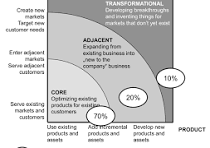
Popularised by innovation strategists Bansi Nagji and Geoff Tuff, the matrix is a planning tool for assessing innovation according to how much change it involves. It considers two questions: how familiar is the customer or market, and how familiar are the products, services or capabilities required?
The three types of innovation
Core innovation
Core innovation improves what an organisation already offers to its existing customers. It usually builds on established capabilities and involves relatively low uncertainty. Examples include making a familiar product easier to use, improving a customer service process or introducing a new feature to an existing service.
Adjacent innovation
Adjacent innovation takes something the organisation already does and applies it to a new customer group, market or use. Alternatively, it may bring an established capability into a new offer. For example, a food company might use its expertise in packaging to develop products for a different sector.
Transformational innovation
Transformational innovation creates something substantially new for customers or markets the organisation does not currently serve. It may require unfamiliar technologies, capabilities or business models. Because there is greater uncertainty, these initiatives often involve more experimentation and a longer time horizon.
How the matrix works
The matrix is usually shown as a grid. One axis represents how familiar the market or customer is; the other represents how familiar the organisation’s products, services and capabilities are. Work close to the organisation’s current position tends to be core innovation. Projects that move into less familiar territory may be adjacent or transformational.
The matrix is not intended to label every idea with absolute precision. Its purpose is to prompt useful discussion: How much are we changing? What do we already know? What assumptions need to be tested? What capabilities will we need to develop?
Using the matrix in practice
- Gather potential initiatives. Include ideas from across the organisation, as well as opportunities identified through customer research, market analysis and technology developments.
- Assess each initiative. Consider the familiarity of its customers, markets, offer and required capabilities. Be honest about what is genuinely new.
- Discuss the level of uncertainty. A project in an unfamiliar market may need a different approach from a small improvement to an established service.
- Review the overall portfolio. Look at where effort, funding and people are concentrated. A portfolio made up only of core improvements may leave the organisation unprepared for future change. A portfolio dominated by ambitious projects may expose it to excessive risk.
- Match governance to the work. Core projects can often be assessed using established measures. More uncertain initiatives may need staged funding, prototypes and learning goals rather than immediate demands for predictable returns.
Why balance matters
A balanced innovation portfolio can support both present performance and future growth. Core initiatives can strengthen existing operations, while adjacent and transformational projects explore new sources of value. The right balance depends on the organisation’s strategy, resources, risk appetite and operating environment; there is no single ideal allocation for every business.
Common pitfalls
- Treating the matrix as a scoring system. It is a conversation and planning tool, not a precise measure of an idea’s quality.
- Assuming transformational means better. A more radical idea is not automatically more valuable or more likely to succeed.
- Using the same approval process for every project. Uncertain initiatives may need room to test assumptions and change direction.
- Ignoring delivery capacity. A portfolio may look balanced on paper but still fail if teams lack the skills, time or leadership support to deliver it.
- Confusing ambition with evidence. Exciting ideas still need customer insight, practical experiments and clear decisions about what to learn next.
Conclusion
The Innovation Ambition Matrix gives organisations a straightforward way to discuss the range of change they are pursuing. By distinguishing between core, adjacent and transformational innovation, leaders can make more deliberate choices about priorities, investment and risk. Used thoughtfully, it helps connect everyday improvements with the longer-term exploration needed to remain relevant and resilient.
7 Tips for Using the Innovation Ambition Matrix Effectively
- Balance core, adjacent and transformational innovation.
- Assess ideas by market newness and offering newness.
- Use clear criteria to place each initiative.
- Protect funding for higher-risk experiments.
- Avoid filling the portfolio with core improvements alone.
- Review the matrix as markets and strategy change.
- Assign owners and measures to every initiative.
Balance core, adjacent and transformational innovation.
A strong innovation portfolio balances core, adjacent and transformational innovation. Core projects improve existing products and services for current customers, while adjacent initiatives take proven strengths into new markets or uses. Transformational projects explore entirely new offers, capabilities or business models. Giving attention to all three helps an organisation improve today’s performance while preparing for future opportunities. The right balance will depend on its strategy, resources and appetite for risk, and should be reviewed as circumstances change.
Assess ideas by market newness and offering newness.
Assess each idea by asking how new its target market is to your organisation and how new the product, service or capability would be. Ideas aimed at familiar customers using an established offering are typically core innovations; those involving a new market or a significantly new offering move towards adjacent or transformational innovation. This simple comparison helps clarify the level of uncertainty, the capabilities required and the kind of testing or investment each idea may need.
Use clear criteria to place each initiative.
Use clear, consistent criteria to place each initiative in the Innovation Ambition Matrix. Consider how familiar its customers and markets are, how much the product or service differs from what you already offer, and whether new capabilities are required. Agreeing these criteria as a team helps reduce subjective judgements and makes it easier to compare initiatives, identify uncertainty and decide what support each one needs.
Protect funding for higher-risk experiments.
Protecting funding for higher-risk experiments helps ensure that promising ideas are not crowded out by projects with quicker, more predictable returns. Set aside a dedicated portion of the innovation budget for testing uncertain concepts, and release it in stages as teams gather evidence. This gives experiments room to learn, adapt or stop early without requiring them to meet the same short-term targets as core improvements. The aim is not to fund every bold idea indefinitely, but to create a disciplined space for exploring opportunities that could support future growth.
Avoid filling the portfolio with core improvements alone.
Avoid filling your innovation portfolio with core improvements alone. While refining existing products and services can deliver valuable gains, relying solely on familiar projects may limit your ability to respond to change or uncover new sources of growth. Make room for adjacent and transformational ideas too, balancing them with your organisation’s strategy, resources and appetite for risk.
Review the matrix as markets and strategy change.
Review the Innovation Ambition Matrix regularly, especially when markets, customer needs, technologies or organisational strategy change. An initiative that once seemed transformational may become a core opportunity as the business builds new capabilities, while shifts in the market may make existing projects less relevant. Revisiting the matrix helps ensure the innovation portfolio remains aligned with current priorities, balances risk appropriately and directs resources towards the opportunities most likely to create value.
Assign owners and measures to every initiative.
Assign a clear owner and meaningful measures to every initiative in the Innovation Ambition Matrix. The owner should be accountable for progress, coordinating the people and resources needed, and raising issues early. Choose measures that fit the initiative: core innovation might be tracked through efficiency, quality or customer satisfaction, while more exploratory projects may be better assessed by milestones, experiments and evidence of customer demand. Clear responsibility and suitable measures make it easier to review progress, learn and decide whether to continue, adapt or stop an initiative.